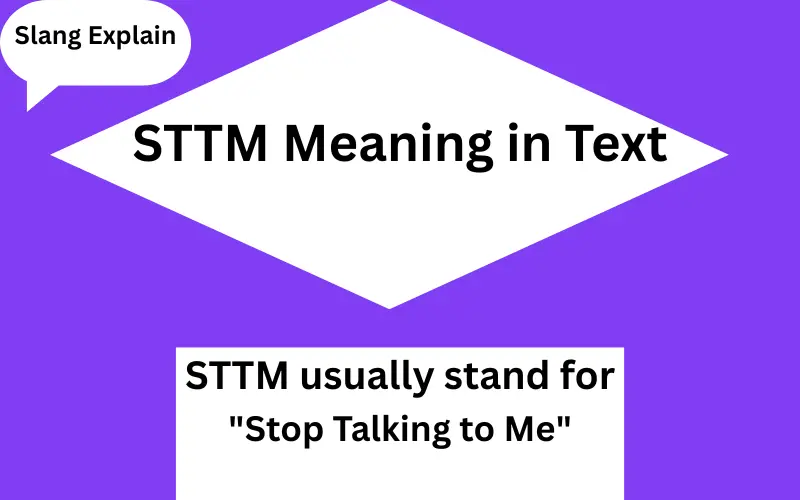
The STTM meaning in text is commonly understood as “Stop Talking to Me.” It’s an internet abbreviation people use when they want to end a conversation, express frustration, or jokingly tell someone to stop messaging them. Depending on the relationship and tone, STTM can sound playful between close friends or serious during an argument. If you’ve searched what does STTM mean in text, STTM mean, or STTM meaning, this guide explains everything you need to know with real examples and practical situations.
Imagine sending your friend ten messages in a row after they spoiled your favorite TV show’s ending. Instead of writing a long reply, they simply text “STTM 😂.” At first glance, those four letters can look confusing, especially if you’ve never seen them before. Many people search what does STTM mean in text after spotting it in a chat because it’s not as common as abbreviations like LOL or BRB.
In most texting conversations, STTM means “Stop Talking to Me.” That doesn’t always mean someone is angry. Sometimes it’s used sarcastically after a funny joke, sometimes after friendly teasing, and sometimes during a genuine disagreement. The key is understanding the tone behind the message rather than the letters themselves. This guide explains the real STTM meaning, when it’s appropriate, when it can sound rude, and how people actually use it in modern conversations.
STTM Meaning at a Glance
| Feature | Details |
| Abbreviation | STTM |
| Most Common Meaning | Stop Talking to Me |
| Tone | Funny, Sarcastic, Frustrated, Serious (depends on context) |
| Common Use | Text messages, group chats, gaming chats, social media |
| Formal or Informal? | Informal |
| Best Used With | Close friends or casual conversations |
What Does STTM Mean in Text?
In texting, STTM usually stands for “Stop Talking to Me.” It’s a quick way to tell someone that you’re done with the conversation—for the moment, or sometimes just as a joke.
Unlike greetings or common abbreviations like TY or GM, STTM expresses a reaction. It often appears after someone says something embarrassing, makes a bad joke, reveals a spoiler, or keeps teasing another person.
For example, if your friend reminds everyone about the time you accidentally sent a message to the wrong group, replying with “STTM 😂” shows playful embarrassment rather than real anger.
On the other hand, if two people are arguing and someone replies with only “STTM.”, the message can sound much more serious.
That’s why context is everything.
Why Do People Say STTM Instead of Writing the Full Sentence?
Digital conversations move fast, and people often rely on abbreviations to express emotions instantly. STTM saves time while also making the reaction feel lighter than writing the complete sentence.
People use STTM because:
- It quickly ends a conversation.
- It shows frustration without writing a long explanation.
- It can make playful teasing funnier.
- It’s short enough for fast-paced chats.
- Friends often understand the joke immediately.
Interestingly, many users don’t literally want the other person to stop talking. Instead, they’re reacting dramatically to something funny or embarrassing.
It’s Usually About Emotion, Not Silence
One mistake many people make is thinking STTM always means someone wants to end the friendship or never talk again.
In reality, that’s rarely the case.
Imagine these situations:
- Your friend beats you again in an online game and starts celebrating.
- Someone spoils tomorrow’s football result.
- A sibling reminds everyone about an embarrassing childhood story.
In all three situations, replying with “STTM 😂” usually means:
“I can’t believe you just said that!”
rather than
“Don’t ever message me again.”
That’s why emojis often change the meaning completely.
Real-Life Examples
| Situation | Natural Example |
| Your friend spoils a movie ending. | “STTM 😭 You ruined it!” |
| Someone wins another game against you. | “Bro… STTM 😂” |
| Your sibling tells an embarrassing story. | “Seriously? STTM.” |
| A friend keeps roasting you in the group chat. | “Nah, STTM 🤣.” |
| Someone exposes your old social media photos. | “Delete those… STTM!” |
| Your teammate blames you for losing. | “STTM, it wasn’t even my fault.” |
Notice that none of these examples feel robotic or repetitive. They reflect the kinds of conversations where people naturally use the abbreviation.
Where You’re Most Likely to See STTM
Unlike popular abbreviations such as LOL or TY, STTM isn’t something you’ll find in every conversation. It’s mostly used in informal spaces where people already know each other and understand each other’s sense of humor.
You’ll commonly see STTM in:
- Private text messages.
- Friend group chats.
- Discord servers.
- Online gaming conversations.
- Instagram DMs.
- Snapchat chats.
- Casual social media comments.
It’s much less common in workplace chats or professional communication because the abbreviation can easily be misunderstood.
When STTM Sounds Funny… and When It Doesn’t
This is where many people get confused.
The exact same abbreviation can sound completely different depending on the conversation.
For example:
A friend sends you a terrible meme.
You reply:
“STTM 😂”
Everyone knows you’re joking.
Now imagine a serious argument where someone replies:
“STTM.”
Without an emoji or any extra context, it sounds much colder and more direct.
That’s why experienced internet users don’t judge STTM by the letters alone—they look at the conversation, relationship, and tone before deciding what it means.
Can STTM Have Other Meanings?
If you search STTM meaning, you’ll occasionally find different expansions depending on the industry or community. Like many abbreviations, STTM isn’t limited to one definition.
For example, in business, technology, or education, the same four letters may stand for completely different phrases. However, those meanings are rare and usually obvious from the surrounding conversation.
When STTM appears in:
- a text message,
- WhatsApp chat,
- Instagram DM,
- Snapchat conversation,
- Discord server,
- or a gaming chat,
it almost always means “Stop Talking to Me.”
That’s why context matters far more than the abbreviation itself.
STTM vs Similar Texting Slang
People often confuse STTM with other reactions because they all express emotions. The difference lies in how those emotions are communicated.
| Abbreviation | Meaning | Emotion It Expresses |
| STTM | Stop Talking to Me | Playful annoyance, frustration, disbelief |
| SMH | Shaking My Head | Disappointment or disbelief |
| IDC | I Don’t Care | Indifference |
| IKR | I Know, Right? | Agreement |
| LOL | Laughing Out Loud | Amusement |
| BRUH | Expression of disbelief | Surprise or frustration |
For instance:
- SMH reacts to someone’s actions.
- STTM reacts directly to the person speaking.
- LOL shows laughter.
- IDC shows a lack of interest.
Choosing the right abbreviation depends on the feeling you want to express.
Is STTM Rude?
This is one of the biggest questions people have after learning the STTM meaning in text.
The answer is:
It depends on your relationship with the other person.
If you send STTM to a close friend after they make a funny joke, they’ll probably laugh because they understand you’re teasing.
However, sending STTM to:
- your manager,
- a customer,
- someone you’ve just met,
- or during a serious discussion
can sound dismissive or even disrespectful.
A good rule is simple:
If you wouldn’t jokingly say “Stop talking to me” in real life, don’t type STTM online either.
Common Mistakes People Make
Although STTM looks simple, people often misunderstand how it’s supposed to be used.
One common mistake is assuming it always means someone is angry. In reality, most uses are humorous, especially among friends who enjoy playful banter.
Another mistake is using STTM in professional communication. Even if you mean it as a joke, the other person may not understand your tone.
Some users also overuse abbreviations. If every conversation includes STTM, LOL, SMH, and BRUH together, your messages may become harder to read and less natural.
Finally, don’t ignore punctuation and emojis.
Compare these:
- STTM 😂 → Clearly playful.
- STTM 😭 → Funny frustration.
- STTM. → Much more serious.
Small details completely change how the message is interpreted.
Tips for Using STTM Naturally
| Tip | Why It Helps |
| Use it only with people who understand your humor. | Prevents misunderstandings. |
| Let the conversation decide the tone. | Context changes the meaning. |
| Add an emoji if you’re joking. | Makes your intention clear. |
| Avoid using it in professional settings. | It can sound rude or disrespectful. |
| Don’t overuse abbreviations in every message. | Natural conversations feel more authentic. |
Using STTM correctly is less about memorizing the abbreviation and more about reading the situation.
Interesting Facts About STTM
One reason STTM isn’t as famous as abbreviations like LOL or BRB is that it’s much more context-driven. People usually type it only when reacting to someone rather than during everyday conversation.
Another interesting point is that many internet users first learn STTM through gaming communities or group chats, where playful teasing is common. It spreads naturally between friends rather than through formal dictionaries or language guides.
You’ll also notice that STTM appears far less frequently than classic texting abbreviations. That makes it unfamiliar to many users, which is why searches for what does STTM mean in text continue to grow whenever people encounter it for the first time.
See Also:
FAQs
What does STTM mean in text?
STTM usually stands for “Stop Talking to Me.” It’s used to express playful annoyance, frustration, or disbelief.
What does STTM mean?
In casual online conversations, it almost always means Stop Talking to Me, although other technical meanings exist in different fields.
Is STTM rude?
Not necessarily. Between close friends it often sounds funny, but in serious conversations it can come across as rude.
Is STTM internet slang?
Yes. It’s an informal texting abbreviation used in chats, messaging apps, and online communities.
Where is STTM commonly used?
You’ll mostly see it in text messages, WhatsApp chats, Discord servers, Instagram DMs, Snapchat, and gaming conversations.
Should I use STTM at work?
No. It’s better to avoid STTM in professional communication because it may be misunderstood.
Why do people say STTM instead of writing the full sentence?
It’s faster, adds humor, and creates a stronger emotional reaction in casual conversations.
Can STTM be used jokingly?
Absolutely. Most people use STTM playfully after a joke, embarrassing moment, or friendly teasing.
Does STTM always mean someone wants to end the conversation?
No. Most of the time, it’s simply an exaggerated reaction rather than a literal request.
What emoji is commonly used with STTM?
😂, 😭, 🤣, 🙄, and 😅 are often paired with STTM to make the tone feel lighter.
Conclusion
The STTM meaning in text is usually “Stop Talking to Me,” but the abbreviation is more about expressing emotion than ending a conversation. Among friends, it’s often a humorous way to react to teasing, embarrassing moments, or unbelievable comments. In more serious discussions, however, the same phrase can sound much stronger, which is why context should always guide how you interpret it.
If you were searching what does STTM mean in text, STTM mean, or simply STTM meaning, remember that the abbreviation is informal and works best in casual chats where everyone understands the tone. Before using it yourself, think about who you’re talking to and whether they’ll read it as a joke or as genuine frustration. That’s the difference between sounding playful and sounding rude.