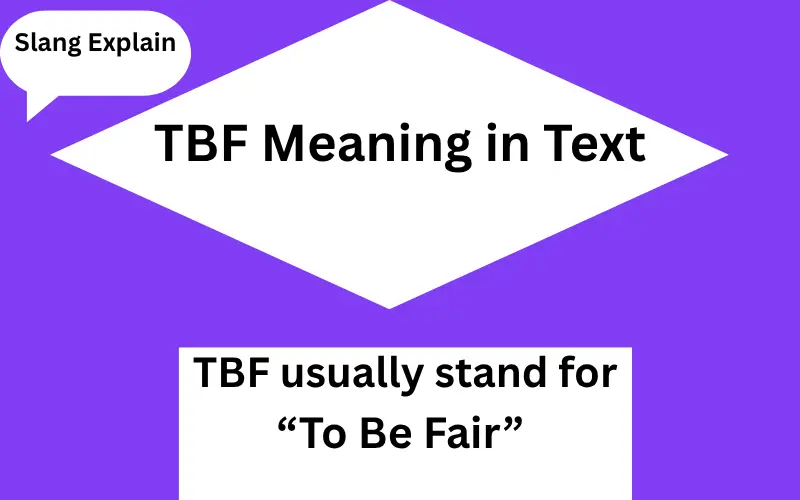
TBF means “To Be Fair” in texting. People use it when they want to add a fair point, acknowledge another side of an argument, or soften what they just said. It can appear in texts, Instagram messages, comments, and casual online conversations.
If someone starts a message with “TBF,” they are usually saying something like “to be fair,” “if we’re being fair,” or “you have to admit.”
For example:
“TBF, you did warn hhhme.”
This means:
“To be fair, you did warn me.”
TBF is especially common when someone wants to balance an opinion instead of making a one-sided statement.
TBF Meaning at a Glance
| Term | Meaning | Typical use |
| TBF | To Be Fair | Adding a balanced point |
| TBF, … | To be fair, … | Introducing another side |
| TBF to him/her | To be fair to him/her | Defending or acknowledging someone |
| But TBF | But to be fair | Softening a criticism |
The abbreviation is informal, so it’s most natural in texts, DMs, social media, and casual conversations.
What Does TBF Mean in Text?
The most common TBF meaning in text is “To Be Fair.”
People use it when they want to recognize something reasonable or give someone credit.
For example:
“I don’t really like the movie, but TBF the acting was good.”
The person still dislikes the movie, but they’re acknowledging a positive point.
Another example:
“TBF, she was never told about the change.”
Here, TBF introduces information that makes the situation look more balanced.
So TBF often works as a conversation-balancing phrase.
Why Do People Use TBF?
TBF is useful because conversations aren’t always completely black and white.
Someone might complain about a person, situation, movie, game, or decision and then realize there’s another side worth mentioning.
Instead of typing:
“To be fair…”
they can simply write:
“TBF…”
It is shorter, quicker, and fits naturally into casual online communication.
TBF can be used to:
- acknowledge someone’s point
- admit someone was partly right
- soften criticism
- add missing context
- defend someone
- recognize a positive detail
- make an opinion sound more balanced
Examples of TBF in Text Messages
Example 1: Admitting Someone Was Right
A: “You said I’d forget my keys.”
B: “TBF, I did warn you 😂”
Here, TBF means “To be fair.”
The speaker is admitting that the other person had a valid point.
Example 2: Giving Someone Credit
A: “I can’t believe he finished all that work.”
B: “TBF, he started really early.”
The second person is adding context that makes the achievement more understandable.
Example 3: Softening Criticism
“TBF, the restaurant wasn’t that bad. The service was just slow.”
The speaker is making their criticism less harsh by acknowledging that the restaurant had some good qualities.
Example 4: Defending Someone
“Everyone is blaming Sarah, but TBF she wasn’t even there.”
Here, TBF introduces a fact that supports Sarah.
Example 5: Casual Conversation
“TBF I would’ve done the same thing 😂.”
The sender is admitting that the other person’s behavior was understandable.
TBF at the Beginning vs. End of a Message
TBF can appear in different parts of a sentence.
At the beginning
“TBF, you were right.”
This is one of the most common formats.
In the middle
“I was annoyed, but TBF I understood why he did it.”
Here, TBF connects two sides of the speaker’s opinion.
Near the end
“She handled it pretty well, TBF.”
In this position, TBF works almost like a final acknowledgment.
The meaning remains “to be fair.”
What Does “TBF to Him” Mean?
You may see messages such as:
“TBF to him, he tried.”
This means:
“To be fair to him, he tried.”
The phrase is often used when someone is being criticized and the speaker wants to point out something positive or reasonable about their actions.
For example:
“TBF to her, nobody explained the rules.”
The speaker isn’t necessarily saying she did everything correctly. They’re simply saying she deserves some consideration because she wasn’t given the information she needed.
TBF Can Change the Tone of a Message
One reason TBF is so common is that it can change how a statement feels.
Compare:
“You messed up.”
with:
“TBF, you weren’t given much time.”
The second statement is more balanced and less aggressive.
Similarly:
“He’s terrible at football.”
sounds very negative.
But:
“TBF, he’s only been playing for a few months.”
adds context and makes the judgment less absolute.
So TBF can function as a tone softener.
Is TBF Positive or Negative?
TBF is neither inherently positive nor negative.
Its purpose is to introduce a fair or balanced observation.
For example:
“TBF, she did a great job.”
Positive.
But:
“TBF, he should’ve known better.”
Negative.
The abbreviation itself doesn’t determine the emotion. The statement that follows it does.
Is TBF Used to Disagree?
Sometimes.
A person can use TBF to partially disagree with someone’s criticism without directly arguing.
For example:
A: “That was completely his fault.”
B: “TBF, nobody told him what to do.”
B isn’t necessarily saying A is completely wrong. They’re pointing out that another factor should be considered.
This is why TBF is common in debates and opinion-based conversations.
TBF in Arguments
TBF can be particularly useful during an argument because it allows someone to recognize part of the other person’s position.
For example:
A: “She shouldn’t have cancelled.”
B: “TBF, she was sick.”
The response doesn’t necessarily settle the argument. It simply adds a reason that should be considered.
Another example:
A: “The game was awful.”
B: “TBF, the graphics were pretty good.”
Again, the speaker is balancing the original opinion.
TBF Meaning in Social Media
You can also find TBF in social media posts, comments, and replies.
For example:
“TBF this update fixed a lot of problems.”
or:
“Everyone is complaining, but TBF the old version wasn’t much better.”
On social platforms, TBF often appears when someone is responding to a popular opinion and wants to introduce a different perspective.
It’s particularly useful in short comments because it communicates “there’s another side to this” without requiring a long explanation.
TBF on Instagram
The TBF meaning on Instagram is generally the same: “To Be Fair.”
You might see it in:
- comments
- DMs
- captions
- Story replies
- group chats
For example:
“TBF you looked good in both pics.”
This could be a response to someone asking which photo is better.
Or:
“TBF, that was actually a good idea.”
Here, the person is giving credit to someone.
TBF in Group Chats
Group chats are another place where TBF appears frequently.
Imagine several friends are complaining about someone:
Friend 1: “He never helps us.”
Friend 2: “TBF, he was working yesterday.”
Friend 2 is adding a fact that changes the picture.
Another example:
Friend 1: “We should’ve started earlier.”
Friend 2: “TBF nobody knew it would take this long.”
This is a natural conversational use of TBF.
TBF vs. TBH
TBF and TBH look similar, but their meanings are different.
TBF = To Be Fair
TBH = To Be Honest
TBF introduces a fair or balancing point.
TBH introduces an honest opinion or admission.
Compare:
“TBF, you did tell me.”
This acknowledges a fair point.
“TBH, I didn’t like it.”
This expresses an honest opinion.
They can even appear together:
“TBH, I didn’t like the movie. TBF, the ending was pretty good.”
The first part gives the speaker’s honest opinion. The second part adds a balanced observation.
TBF vs. IMO
These abbreviations also serve different purposes.
TBF = To Be Fair
IMO = In My Opinion
TBF is about balance or acknowledgment.
IMO tells you that what follows is the sender’s personal opinion.
For example:
“IMO, the first movie was better.”
means the sender is sharing an opinion.
Whereas:
“TBF, the second movie had better effects.”
adds a fair point to the discussion.
TBF vs. NGL
TBF and NGL are also sometimes used together.
TBF = To Be Fair
NGL = Not Gonna Lie
For example:
“NGL, I didn’t expect to like it. TBF, it was actually pretty good.”
The sender first gives an honest admission and then acknowledges a positive point.
Understanding both makes the tone of the message much easier to read.
Does TBF Mean “To Be Frank”?
In standard texting slang, TBF usually means “To Be Fair,” not “To Be Frank.”
“To be frank” is another English expression meaning to speak honestly or directly, but it is not the standard expansion of TBF in casual messaging.
So if you see:
“TBF, I think you’re right.”
the intended meaning is normally:
“To be fair, I think you’re right.”
Can TBF Be Sarcastic?
Yes.
Like many internet abbreviations, TBF can be used sincerely or sarcastically.
For example:
“TBF, he only broke three things this time 😂.”
The speaker may technically be giving him credit, but the statement is clearly humorous.
Another example:
“TBF, you only arrived an hour late.”
Depending on the context, this could be genuine or sarcastic.
The surrounding words, emojis, and relationship between the people determine the tone.
How to Reply When Someone Says TBF
You don’t need a special response to TBF. Reply to the actual point they’re making.
If you agree
“Yeah, that’s fair.”
If you disagree
“I get that, but I still think…”
If they’re defending you
“Exactly 😂.”
If they made a good point
“Okay, you have a point.”
If they’re joking
“Fair enough 😂.”
The important thing is to respond to the statement after TBF, not to the abbreviation itself.
TBF in Different Situations
| Situation | Example | What TBF does |
| Argument | “TBF, you did warn me.” | Acknowledges a valid point |
| Criticism | “TBF, she wasn’t told.” | Adds context |
| Compliment | “TBF, he did well.” | Gives credit |
| Debate | “TBF, both sides have issues.” | Balances the discussion |
| Joke | “TBF, you only broke one thing 😂.” | Adds humorous fairness |
| Social media | “TBF, this update is better.” | Challenges a negative opinion |
When Should You Use TBF?
TBF works best when you are having a casual conversation and want to make a balanced point quickly.
It’s natural in:
- texting
- Snapchat
- TikTok comments
- Discord
- group chats
- casual conversations
Avoid relying on TBF in formal writing unless you’re deliberately quoting informal language.
In a professional message, simply write “To be fair” if you actually need the phrase.
See Also
- TBH Meaning in Text – See how TBH is used when someone wants to be honest in a conversation.
- GTB Meaning in Text – Learn what GTB means and why people use it when ending a chat.
- XD Meaning in Text – Find out what XD means and how it expresses laughter in online chats.
- CMP Meaning in Text – Discover the common meanings of CMP and how context changes its use.
- IGH Meaning in Text – Understand what IGH means when someone uses it in texting or social media.
FAQs
What does TBF mean in text?
TBF usually means “To Be Fair.” It’s used to introduce a balanced point, acknowledge someone’s side, or add context to a statement.
What does TBF mean in texting?
In texting, TBF means “To Be Fair.” It’s commonly used in casual conversations when someone wants to recognize a reasonable point or soften criticism.
What does TBF mean?
TBF most commonly stands for “To Be Fair.” In casual messages, it can introduce an explanation, defense, acknowledgment, or opposing point.
Is TBF the same as TBH?
No. TBF means “To Be Fair,” while TBH means “To Be Honest.” TBF focuses on fairness or balance, while TBH introduces an honest opinion or admission.
Can TBF be sarcastic?
Yes. TBF can be used sarcastically when the surrounding message or situation makes the intended tone humorous or ironic.
Conclusion
TBF means “To Be Fair” in texting.
People use it when they want to acknowledge another side of a situation, give someone credit, add context, or soften a criticism.
For example:
“TBF, you did warn me.”
means:
“To be fair, you did warn me.”
TBF isn’t automatically positive, negative, sarcastic, or flirty. The sentence around it determines the tone.
If you remember one thing, remember:
TBF = To Be Fair = introducing a point that makes a conversation more balanced.