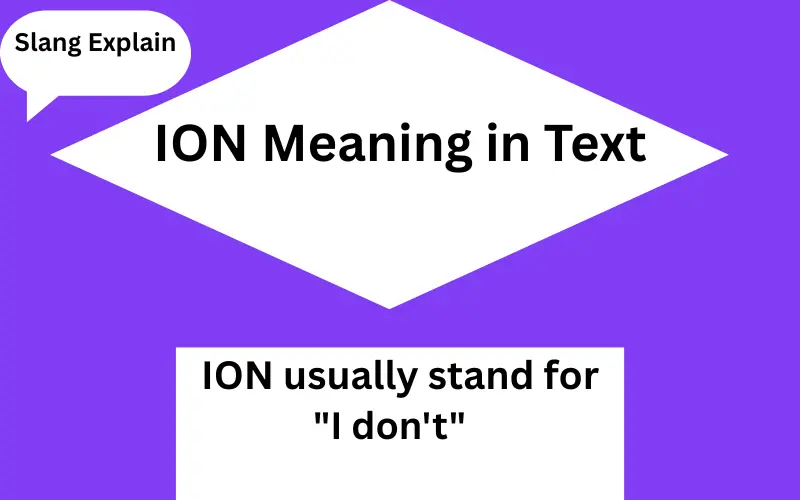
Ion meaning in text usually stands for “I don’t” and is a shortened form commonly used in casual texting and online slang. It is often written as a quick, informal version of “I don’t,” especially in phrases like “ion know” for “I don’t know” or “ion want to” for “I don’t want to.”
If you’ve ever received a message that says “ion know” or “ion even care”, you may have wondered why someone suddenly started talking about chemistry. In texting slang, however, ion usually has nothing to do with science. It is a phonetic spelling of “I don’t” that developed from casual speech and online communication.
The ion meaning in text is especially common in informal conversations, social media posts, and messages where people write the way they naturally speak. If you’re searching what does ion mean in text, what ion mean in text, or what does ion mean in slang, the answer is usually simple: “I don’t.” The rest of the sentence tells you exactly what the person doesn’t know, want, like, or agree with.
At a Glance
| Term | Details |
| Abbreviation | Ion |
| Common Text Meaning | I don’t |
| Tone | Very casual, informal |
| Common Platforms | Text messages, TikTok, Snapchat, Instagram, X, Discord |
| Used When | Saying “I don’t” quickly in casual conversations |
What Does Ion Mean in Text?
In texting and internet slang, ion is commonly used as a shortened or phonetic version of “I don’t.”
For example:
“Ion know what you’re talking about.”
This means:
“I don’t know what you’re talking about.”
The spelling reflects casual pronunciation rather than standard written English. Because of this, ion is most natural in informal messages where people are comfortable using slang.
You’ll often see it before another verb or phrase:
- Ion know = I don’t know
- Ion want to = I don’t want to
- Ion care = I don’t care
- Ion think so = I don’t think so
- Ion remember = I don’t remember
The abbreviation itself doesn’t change the meaning of the sentence. It simply makes the message sound more casual and conversational.
Why Do People Use Ion?
People use ion because it matches the way some people pronounce “I don’t” in relaxed speech.
It Makes Messages Faster
Instead of typing:
“I don’t know.”
someone may write:
“Ion know.”
The shorter version is quick and natural in informal conversations.
It Reflects Spoken Language
Texting slang often develops from pronunciation. Ion is an example of someone writing a phrase according to how it sounds when spoken casually.
It Adds a Casual Tone
” I don’t know” sounds neutral, while “ion know” can feel more relaxed, conversational, or slang-heavy.
It Fits Social Media Culture
Shortened spellings are common across social media, especially in captions, comments, and casual messages. Ion fits naturally into that style of communication.
Real-Life Examples of Ion in Texting
| Situation | Example | Standard Meaning |
| Not knowing | “Ion know what happened.” | I don’t know what happened. |
| Refusing | “Ion want to go.” | I don’t want to go. |
| Showing indifference | “Ion care anymore.” | I don’t care anymore. |
| Disagreeing | “Ion think that’s right.” | I don’t think that’s right. |
| Forgetting | “Ion remember his name.” | I don’t remember his name. |
These examples show how flexible ion can be. The word that follows it determines the complete meaning.
Ion in a Normal Conversation
Imagine a friend asks:
“Are you coming to the party tonight?”
You reply:
“Ion know yet.”
The meaning is simply:
“I don’t know yet.”
Now consider another conversation:
“Do you want to watch another movie?”
“Ion really feel like it.”
Here, the sender means:
“I don’t really feel like it.”
In both examples, ion replaces the words “I don’t” without changing the basic message.
What Does Ion Mean in Slang?
In slang, ion is a casual spelling of “I don’t.” It is particularly common in phrases that begin with “I don’t,” making the message shorter and more reflective of everyday speech.
For example:
“Ion even know why you asked me.”
means:
“I don’t even know why you asked me.”
The slang version can give the message a more relaxed or conversational feel.
However, ion is not appropriate for formal writing. It belongs mainly in casual online communication and informal conversations.
Ion Meaning on TikTok, Snapchat, and Social Media
The ion meaning in text generally stays the same across social platforms, although the way people use it can vary slightly.
TikTok
On TikTok, ion may appear in captions, comments, or replies. Users often combine it with other slang to create a conversational style.
“Ion know who needs to hear this.”
Snapchat
On Snapchat, ion is commonly used in quick messages between friends.
“Ion wanna go out tonight 😂”
Instagram users may use ion in DMs, comments, or captions when writing in a casual voice.
“Ion even remember posting that.”
Discord
In Discord chats, ion may appear in informal conversations between friends or gaming communities.
The platform doesn’t change the basic definition. In most casual contexts, ion means “I don’t.”
Ion vs IDK: What’s the Difference?
Ion and IDK can both appear when someone doesn’t know something, but they are not interchangeable in every sentence.
| Term | Meaning | Example |
| Ion | I don’t | “Ion know.” |
| IDK | I don’t know | “IDK.” |
| IDC | I don’t care | “IDC what happens.” |
| IDM | I don’t mind | “IDM where we go.” |
The main difference is that ion replaces the phrase “I don’t”, while abbreviations such as IDK and IDC represent complete expressions.
For example:
“Ion know.”
means:
“I don’t know.”
But:
“IDK.”
already communicates the complete idea.
If you want to explore another informal abbreviation, you can check our guide to JDP meaning in text.
When Should You Use Ion?
Ion is best suited to casual communication with people who are familiar with internet slang.
You can use it in:
- Text messages
- Social media comments
- Snapchat chats
- TikTok conversations
- Instagram DMs
- Casual group chats
- Friendly Discord conversations
For example:
“Ion know if I’ll be free tonight.”
This sounds natural in an informal conversation.
When Should You Avoid Using Ion?
Although ion works well in casual texting, it should generally be avoided in formal communication.
Don’t use it in:
- Job applications
- Business emails
- Academic assignments
- Professional reports
- Official documents
- Formal customer messages
Instead of writing:
“Ion know if I can make it.”
write:
“I don’t know if I can make it.”
The standard version is clearer and appropriate for a wider range of readers.
Common Mistakes People Make With Ion
Thinking Ion Refers to Chemistry
The word “ion” has a scientific meaning, but in casual texting, it often means “I don’t.” The surrounding sentence usually makes the intended meaning obvious.
Assuming Ion Means “I Know”
Because the spelling is unusual, some readers may initially misread it. In phrases like “ion know,” however, the intended meaning is “I don’t know.”
Using Ion in Formal Writing
Ion is slang and phonetic texting language. It should generally stay in casual conversations rather than professional or academic writing.
Treating Ion as a Complete Sentence
Ion usually works as part of a larger phrase, such as “ion know” or “ion care.” The words that follow it provide the rest of the meaning.
See Also
- IDK Meaning in Text — Learn how IDK is used when someone doesn’t know the answer.
- IDC Meaning in Text — Find out what IDC means when someone wants to express indifference.
- IDM Meaning in Text — See how IDM is used to say that someone doesn’t mind.
- NVM Meaning in Text — Understand the abbreviation people use when they want to dismiss or withdraw something.
- WTV Meaning in Text — Explore how WTV is used to express “whatever” in casual conversations.
FAQs
What does ion mean in text?
Ion usually means “I don’t” in casual texting and internet slang. For example, “ion know” is a shortened way of saying “I don’t know.”
What does ion mean in slang?
In slang, ion is a phonetic spelling of “I don’t.” It is commonly used in informal messages and social media posts to make writing sound more like casual speech.
What does ion mean on TikTok?
On TikTok, ion generally means “I don’t.” You may see it in captions or comments such as “ion know who needs to hear this,” meaning “I don’t know who needs to hear this.”
Is ion the same as IDK?
No. Ion means “I don’t,” while IDK means “I don’t know.” Ion can be followed by different words, such as “ion care” or “ion want to,” while IDK already expresses a complete idea.
Is ion formal or informal?
Ion is very informal texting slang and is best used with friends or on social media. It is not suitable for professional emails, academic writing, or official communication.
Conclusion
The ion meaning in text is usually “I don’t.” It is a casual, phonetic spelling used in phrases such as “ion know,” “ion care,” and “ion want to,” making messages sound more like relaxed everyday speech.
If you’ve searched what does ion mean in text, what ion mean in text, or what does ion mean in slang, remember that the surrounding words complete the meaning. In casual online conversations, ion is generally a simple way to write “I don’t” without typing the full phrase.