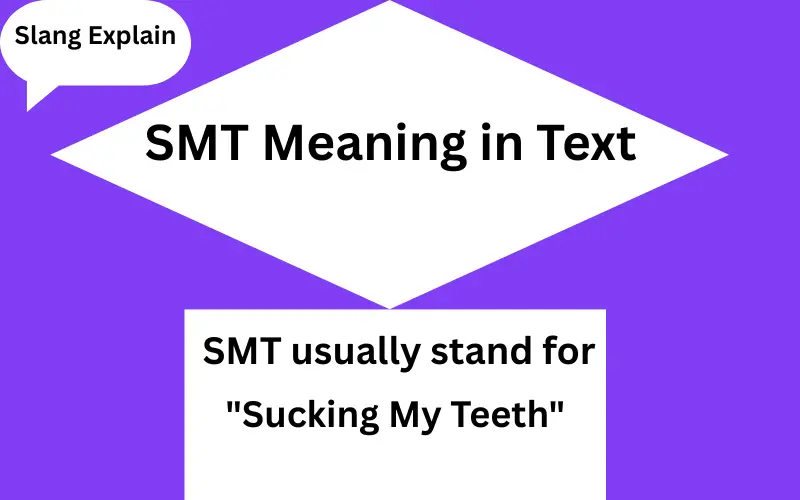
The SMT meaning in text most commonly stands for “Sucking My Teeth.” It is a popular internet slang used to express annoyance, frustration, disappointment, or disapproval in a text conversation. Instead of describing their feelings in a long sentence, many people simply type SMT to show irritation or dissatisfaction during chats on WhatsApp, Snapchat, Instagram, TikTok, Discord, and other messaging platforms.
Example:
Alex: The meeting got delayed again.
Jordan: SMT. This always happens.
In this conversation, SMT means “Sucking My Teeth,” expressing frustration with the repeated delays.
The SMT meaning in text often confuses people because these three letters can represent different phrases depending on the conversation. However, in modern texting and social media, SMT usually stands for “Sucking My Teeth,” an expression people use when they’re annoyed, disappointed, or unhappy about something. Instead of explaining their emotions with several sentences, they simply type SMT to let others know they’re frustrated.
If you’ve been searching what does SMT mean in text, what does SMT stand for, or wondering is it what SMT mean in texting, you’ve come to the right place. This guide explains the complete meaning of SMT, how people use it in text messages, real chat examples, its use across popular social media platforms, similar slang terms, common replies, and other possible meanings. By the end of this article, you’ll know exactly what SMT means and when it’s appropriate to use it in everyday conversations.
SMT Meaning at a Glance
| Term | Meaning |
| SMT | Sucking My Teeth |
| Category | Texting Slang / Internet Acronym |
| Tone | Annoyed, Frustrated, Disappointed |
| Common Platforms | WhatsApp, Snapchat, Instagram, TikTok, Discord |
| Purpose | To express frustration, irritation, or disapproval |
What Does SMT Mean in Text?
If you’re searching what does SMT mean in text, the most common answer is “Sucking My Teeth.” This phrase describes the sound someone makes by sucking air through their teeth to show annoyance or frustration. Although the sound is made in real life, people now use SMT in text messages to represent the same emotion without actually making the noise.
For example, if someone cancels plans at the last minute or something doesn’t go as expected, a person may simply reply with “SMT.” That short response immediately tells the other person they’re disappointed or irritated.
Consider this conversation:
Emma: The concert was canceled because of the weather.
Liam: SMT. I was really looking forward to it.
Here, Liam uses SMT to express disappointment about missing the concert.
Another example:
Friend: The restaurant is fully booked.
You: SMT. We’ll have to find another place.
In this case, SMT shows mild frustration rather than anger.
The SMT meaning in text is commonly seen in casual conversations where people react quickly to unexpected news. Instead of typing “That’s really annoying” or “I’m disappointed,” they simply use SMT because it’s short, easy to type, and instantly understood by many internet users.
What Does SMT Stand For?
Many people ask what does SMT stand for after seeing it in a message or social media comment.
In texting, the most common full form is:
SMT = Sucking My Teeth
Each letter represents:
- S = Sucking
- M = My
- T = Teeth
The phrase comes from a real facial expression and sound that people make when they’re annoyed or disapproving of something. Over time, that expression became part of online conversations, where people now type SMT instead of making the sound.
For example:
“SMT… Another traffic jam.”
Meaning:
“I’m annoyed that there’s another traffic jam.”
Another example:
“SMT. My internet stopped working again.”
Meaning:
“I’m frustrated because my internet isn’t working.”
Although the phrase sounds unusual if you’ve never heard it before, it’s widely recognized in texting culture and social media conversations.
Why People Use SMT
The SMT meaning in text has become popular because it quickly communicates an emotion without requiring a long explanation. Modern conversations often move fast, and abbreviations help people react immediately to news, messages, or situations.
Instead of writing:
“That’s really frustrating.”
People simply write:
SMT
The emotion is still clear, but the message is much shorter.
People commonly use SMT to:
- Express disappointment.
- React to bad news.
- Show mild frustration.
- Respond to annoying situations.
- Express disapproval without writing long messages.
For example:
“SMT. We missed the train.”
This instantly tells the reader that the sender is frustrated about missing the train.
Because emotions are a big part of online conversations, abbreviations like SMT have become common across many messaging platforms.
How SMT Is Used in Text Messages
The SMT meaning in text appears in many different types of conversations. People use it whenever something doesn’t go as planned or when they want to show they’re unhappy about a situation.
For example:
Friend: Our favorite café is closed today.
Reply: SMT. I was craving coffee.
Here, SMT expresses disappointment in a natural way.
Another conversation:
Alex: They moved the exam to Monday.
Taylor: SMT. I wanted more time to study.
Again, SMT replaces a longer emotional response.
Sometimes SMT appears by itself.
Example:
SMT.
Even without additional words, the meaning is usually clear because the previous message provides enough context.
It may also appear before a sentence.
Example:
SMT… Why does this always happen?
This adds emphasis and makes the frustration more obvious.
People also use SMT after receiving unexpected news.
Example:
The flight has been delayed again.
SMT. Hopefully it leaves soon.
In each of these situations, SMT works as a quick emotional reaction rather than a complete sentence.
Real Chat Examples
| Text Message | Meaning |
| SMT. | I’m annoyed. |
| SMT… Not again. | I’m frustrated this happened again. |
| SMT, the internet is down. | I’m disappointed the internet stopped working. |
| SMT. We missed the bus. | I’m upset we missed it. |
| SMT! This day keeps getting worse. | I’m frustrated with today’s events. |
SMT Meaning on WhatsApp, Snapchat, Instagram & TikTok
The SMT meaning in text remains the same across most social media platforms, although the situations where people use it may vary slightly.
SMT Meaning on WhatsApp
On WhatsApp, SMT is often used when reacting to disappointing news or everyday problems. Someone might send “SMT. The movie tickets are sold out.” This immediately tells the other person they’re unhappy about the situation. Because WhatsApp is mainly used for personal conversations, SMT appears naturally between friends and family members.
SMT Meaning on Snapchat
On Snapchat, users often type SMT in private chats after something unexpected happens. For example, someone may write “SMT 😒” after missing an event or dealing with a frustrating situation. Emojis are often added to strengthen the emotion behind the message.
SMT Meaning on Instagram
Instagram users commonly use SMT in direct messages, comments, and story replies. If someone shares bad news or complains about a problem, another person may respond with “SMT, that’s so unfair.” In this context, SMT expresses sympathy while also showing frustration.
SMT Meaning on TikTok
On TikTok, SMT frequently appears in comments when users react to disappointing videos, unexpected endings, or relatable everyday situations. A comment like “SMT… I thought it would end differently.” shows disappointment without needing a lengthy explanation.
SMT vs Similar Slang
Texting abbreviations often look alike, but they don’t always express the same feeling. While SMT is used to show frustration or disappointment, other slang terms have completely different purposes. Knowing the difference helps you use the right abbreviation in the right situation.
| Slang | Meaning | When It’s Used |
| SMT | Sucking My Teeth | To express annoyance or frustration |
| SMH | Shaking My Head | To show disbelief or disappointment |
| UGH | Expression of frustration | When something is irritating |
| TBH | To Be Honest | To share an honest opinion |
| IDC | I Don’t Care | To show a lack of interest |
Although SMT and SMH both express negative emotions, they aren’t identical. SMH usually shows disbelief or disappointment with someone’s actions, while SMT represents the sound of sucking your teeth, which signals irritation or annoyance. In many conversations, they can appear together, but each adds a slightly different emotional tone.
For example:
Friend: He canceled our plans again.
Reply: SMT. SMH.
Here, SMT expresses frustration, while SMH shows disappointment.
Other Meanings of SMT
If you’ve searched what does SMT mean in text, you’ll usually find “Sucking My Teeth.” However, like many abbreviations, SMT can have different meanings depending on the industry or conversation.
For example, SMT may stand for:
- Surface Mount Technology in electronics.
- Simultaneous Multithreading in computer hardware.
- Company or organization names.
- Project titles or product codes.
- Usernames or brand abbreviations.
Consider these examples:
“The factory uses SMT machines.”
Here, SMT refers to Surface Mount Technology, not texting slang.
Another example:
“This processor supports SMT.”
In this case, SMT means Simultaneous Multithreading, a computing feature.
However, in casual conversations on WhatsApp, Snapchat, Instagram, TikTok, or regular text messages, SMT almost always means “Sucking My Teeth.” Reading the surrounding messages will quickly help you identify the intended meaning.
How to Reply to SMT
When someone sends SMT, they’re usually expressing frustration or disappointment. Your reply should acknowledge their feelings and continue the conversation naturally.
Here are a few examples:
Reply 1
“I know. That’s really frustrating.”
Reply 2
“Hopefully things get better soon.”
Reply 3
“Same here. Today hasn’t been easy.”
Reply 4
“Let’s hope tomorrow goes better.”
Reply 5
“I understand why you’re annoyed.”
The best response depends on the situation. If someone is simply venting, a supportive reply is usually enough. If the problem can be solved, suggesting a solution also works well.
Common Mistakes
Although SMT is easy to use, people sometimes misunderstand or misuse it.
One common mistake is assuming SMT has only one meaning everywhere. While it usually means “Sucking My Teeth” in texting, it can represent technical terms or organization names in other contexts.
Another mistake is using SMT in formal communication. Since it’s internet slang, it’s not suitable for business emails, official reports, or professional conversations. Writing the complete sentence is always the better choice in formal situations.
People also confuse SMT with abbreviations like SMH because both express negative emotions. Remember that SMT focuses on irritation, while SMH usually expresses disbelief or disappointment.
Finally, avoid using SMT if you’re unsure whether the other person understands texting abbreviations. Writing your feelings clearly prevents confusion.
Tips for Using SMT Correctly
Using SMT naturally becomes easy once you know when it fits the conversation.
- Use SMT only in casual conversations.
- Type it when you’re mildly annoyed or disappointed.
- Make sure the context clearly explains why you’re frustrated.
- Avoid using SMT in formal or professional messages.
- Don’t overuse it in every conversation.
- Read previous messages before deciding what SMT means.
Following these simple tips helps you communicate naturally without confusing the other person.
Where SMT Is Commonly Used
| Platform | How SMT Is Used | Example |
| Reacting to everyday frustrations | “SMT. The bus is late again.” | |
| Snapchat | Responding to disappointing moments | “SMT 😒” |
| Comments and direct messages | “SMT, that’s unfortunate.” | |
| TikTok | Reacting to relatable situations | “SMT… I expected a different ending.” |
See Also:
FAQs
What does SMT mean in text?
The SMT meaning in text most commonly stands for “Sucking My Teeth.” It’s used to express annoyance, frustration, or disappointment during online conversations.
What does SMT stand for?
In texting, SMT stands for Sucking My Teeth, a phrase that represents an annoyed or disapproving reaction.
Is it what SMT mean in texting?
Yes. In most text messages and social media conversations, SMT means Sucking My Teeth and is used to show frustration or irritation.
Is SMT positive or negative?
SMT generally carries a negative tone because it’s used when someone is unhappy, annoyed, or disappointed about a situation.
Where is SMT commonly used?
You’ll commonly see SMT on WhatsApp, Snapchat, Instagram, TikTok, Discord, Messenger, and SMS conversations.
Can SMT have more than one meaning?
Yes. Besides texting slang, SMT can also refer to Surface Mount Technology, Simultaneous Multithreading, and other technical or organizational terms.
Is SMT the same as SMH?
No. SMT expresses annoyance or irritation, while SMH means Shaking My Head, which usually shows disappointment or disbelief.
Should I use SMT in professional communication?
No. SMT is informal internet slang and isn’t appropriate for workplace emails or official communication.
How should I reply to SMT?
You can reply with supportive messages such as “I know, that’s frustrating,” “Hopefully things improve,” or “I understand why you’re upset.”
Why do people use SMT instead of writing a full sentence?
People use SMT because it’s short, easy to type, and instantly communicates frustration without needing a lengthy explanation.
Conclusion
The SMT meaning in text most commonly stands for “Sucking My Teeth.” It’s a popular texting abbreviation that helps people express frustration, disappointment, or annoyance in a quick and simple way. Whether you’re chatting on WhatsApp, Snapchat, Instagram, TikTok, or another messaging platform, SMT allows you to react naturally without typing a long explanation.
If you were searching what does SMT mean in text, what does SMT stand for, or wondering is it what SMT mean in texting, the answer is clear. In most online conversations, SMT means “Sucking My Teeth.” Once you know its meaning and the context in which it’s used, you’ll be able to recognize it easily, use it appropriately, and understand modern text conversations with greater confidence.